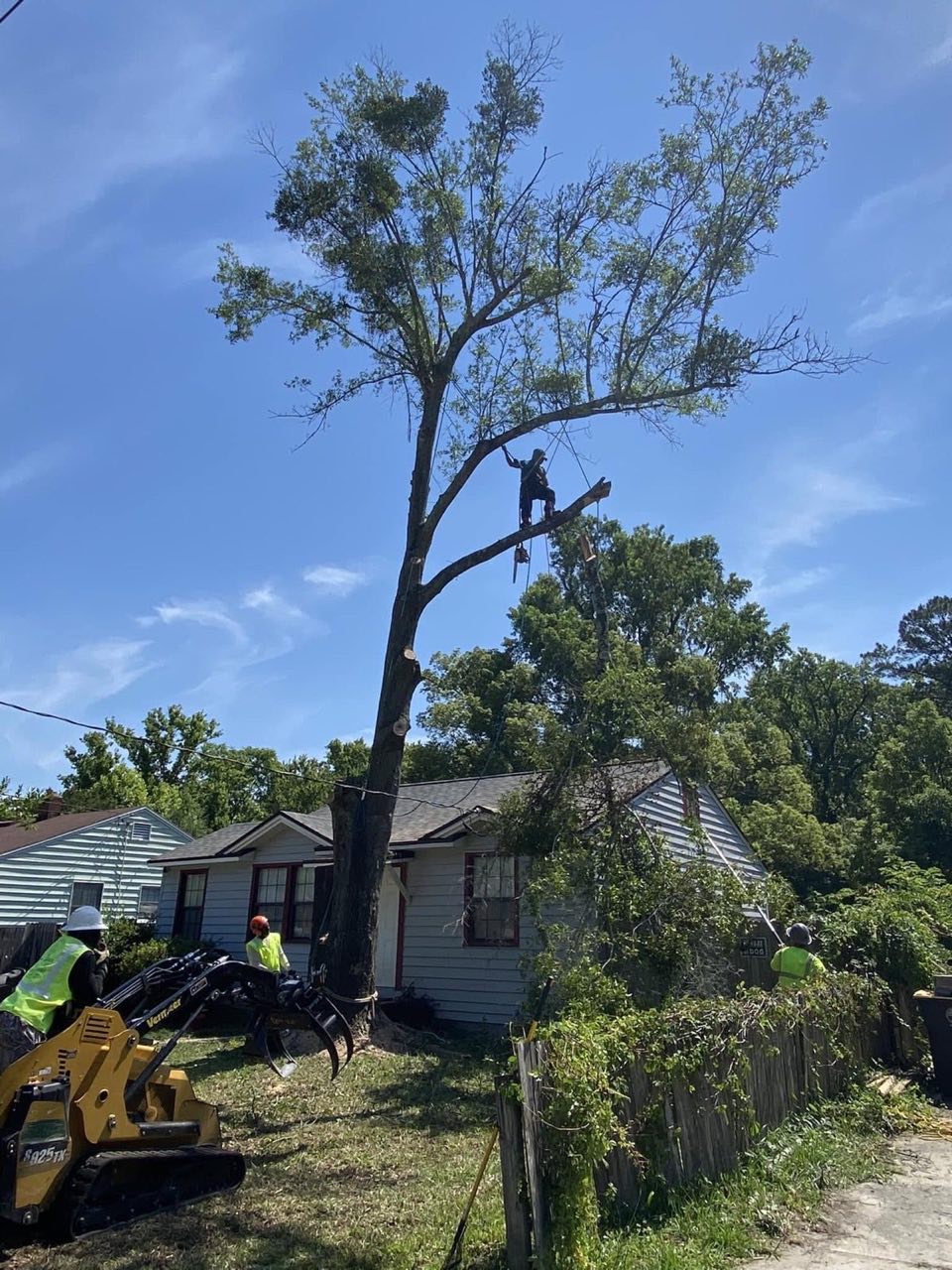
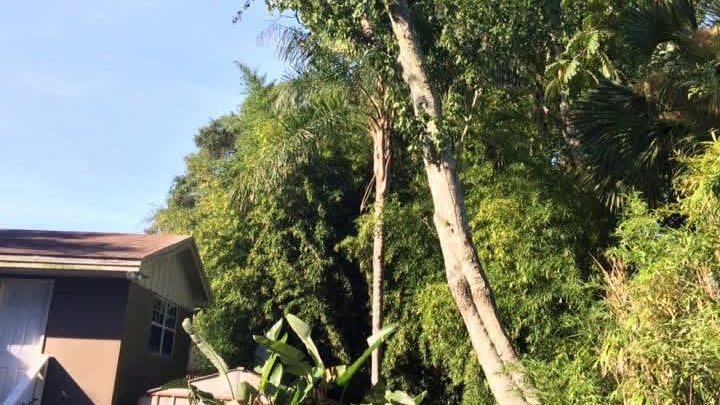
Nobody wants to take down a healthy tree, and most of the time you don't have to. Trimming solves a lot. But some trees are past that point, and they usually give you warnings before they fail. Here's what we look for when a Jacksonville homeowner asks us whether a tree can stay.
How do you know when a tree needs to come down?
A tree usually needs to come down when its structure is failing, not just when it looks rough. The warning signs that matter most are a lean that is new or getting worse, large dead limbs in the canopy, mushrooms or other fungus growing at the base, deep cracks or big hollow cavities in the trunk, roots that were cut or damaged by construction, and a tree that has simply died. Any one of these can be enough on its own, and two or more together mean the tree deserves a professional look soon. In Jacksonville the stakes are higher than in calmer climates, because tropical storms test every weak point a tree has. If a tree near your house is showing these signs, get it looked at before storm season rather than after. Here's each sign in detail.
1. It's leaning more than it used to
Plenty of trees grow at an angle and are perfectly stable. The problem is a new lean, or one that's getting worse. If the ground on one side of the trunk is lifting or cracking, the root plate is moving, and that tree is telling you it's losing its grip.
2. Big dead limbs in the canopy
Dead branches drop without warning, and the large ones over a roof, a driveway, or a kids' play area are the ones that matter. A tree with a few dead twigs is normal. A tree where whole limbs have died back is a different conversation.
3. Mushrooms or fungus at the base
Fungus growing on the trunk or the ground right at the base often means decay in the roots or the lower trunk, the parts holding everything up. You can't see how far the rot goes from the outside, which is exactly why it's worth having someone look.
4. Cracks and cavities in the trunk
A vertical crack in the trunk, or a hollow you could fit your arm into, weakens the structure of the whole tree. Small cavities in a big healthy tree can be fine. Large ones, or cracks that run deep, usually aren't.
5. Damaged or cut roots
If there's been construction, trenching, or a new driveway near the tree in the last few years, the roots may have been cut on one side. The tree can look fine above ground for a long time after that and still be far weaker than it appears. We see this most where a driveway or a utility trench went in a few years back and the tree beside it is only now starting to show it.
6. The tree is dead
It sounds obvious, but dead trees get left standing all the time. No leaves in spring, bark sloughing off, woodpeckers working the trunk hard. In Florida's heat and rain, a dead tree gets brittle fast, and every month it stands it becomes more dangerous to take down.
Can the risky parts just be trimmed instead?
Sometimes, and it's always worth asking. If the problem is a couple of dead limbs over the driveway on an otherwise healthy tree, a good trim removes the hazard and keeps the shade. The same goes for a healthy canopy that's grown over the roofline: cutting it back off the house is routine work. Where trimming stops being the answer is when the problem lives in the structure itself. A trunk that's cracked or hollowing, a root system that's failing, or a tree that's mostly dead can't be trimmed back to safe, because the part that fails in a storm is the part holding everything up. On estimates, if a trim fixes it, you get a trim quoted, and if it doesn't, we'll tell you why.
Why this matters more in Jacksonville
We get tropical storms and the occasional hurricane, and a weakened tree that survived twenty quiet summers can come apart in one bad afternoon. "It's made it this long" is not a safety plan. Water oaks and laurel oaks in particular age out faster than people expect, and they're everywhere in the older parts of Jacksonville and Orange Park.
What we check during a free estimate
When we come out to look at a tree, we look at the lean from two sides, check the base for fungus and soil movement, and scan the canopy for deadwood. Just as important, we look at what the tree would hit if it failed: the roof, the fence, the pool screen, the neighbor's shed, the line to the house. We also pay attention to what's around it, because taking out one tree can change how wind moves through the ones left standing. You get a written quote, free, and if the tree can be saved with a trim instead of a removal, that's what we'll tell you.
The quick checklist
- Is the lean new, or getting worse?
- Are there big dead limbs over anything you care about?
- Mushrooms or fungus at the base?
- Cracks or large hollows in the trunk?
- Any digging or construction near the roots in recent years?
- Did it leaf out this spring?
What to do about it
Don't climb it, and don't take a chainsaw to anything over your head. Have someone who does this every day come look at it. Call (904) 472-4860 or request a quote online. And once the tree is down, the job usually isn't quite finished: here's what to do about the stump.